
Compression Molding vs Injection Molding: When Converting an Existing Rubber Part Pays Off
Most articles about compression molding vs injection molding assume you’re starting with a new design and need to pick a process. But many of the parts we see at Moldtech have been running in compression molds for years. For those parts, the question isn’t which process to choose. It’s whether it’s finally time to switch.
That’s a different decision. Your tooling is paid for, your compound is approved, and your customers have signed off on the part. Converting adds new costs and risks, so the payoff has to be real. In this blog, we’re breaking down the signs a part is ready to convert, how to run the break-even math, what changes during a conversion, and when it’s better to leave a part where it is.
Compression Molding vs Injection Molding for Parts Already in Production
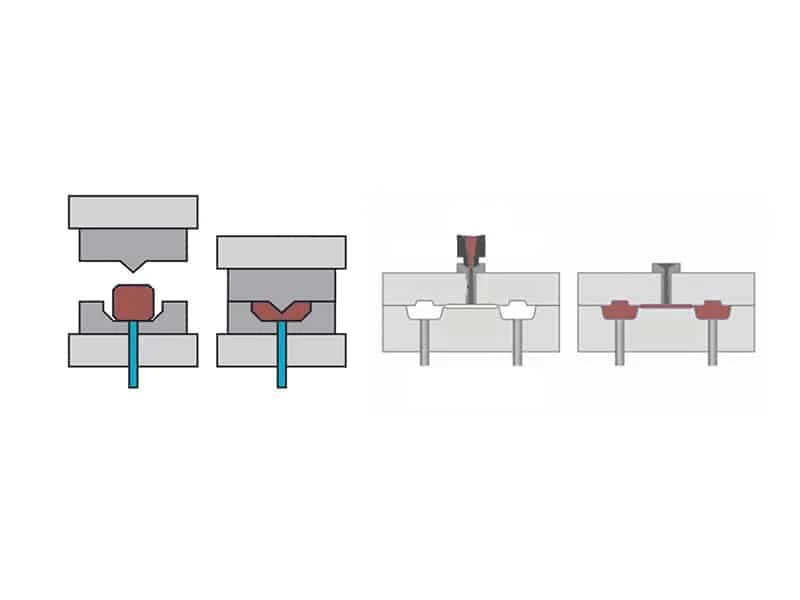
In compression molding, a technician places a preform of uncured rubber into an open, heated cavity. The mold closes, the rubber takes shape and cures, and excess material escapes as flash that must be removed later. In rubber injection molding, compound is preheated in a barrel and injected into a closed mold. Because the rubber enters the cavity hot, cure times are usually shorter, and the process produces less flash and is easier to automate. For a full overview, see our post on compression vs. injection molding for custom molded rubber seals.
For a new part, you weigh these trade-offs once. For an existing part, your compression tooling is already paid for, so an injection mold has to earn back its cost through lower part cost, better quality, or both. That’s why volume, labor, and remaining program life matter so much.
Signs Your Part Is Ready to Convert
No single factor decides a conversion, but several warning signs tend to show up together. The most common is volume growth. A part that launched at a few thousand pieces a year may now run in the hundreds of thousands, and compression molding’s longer cycles and manual loading add up quickly at that scale.
Secondary finishing is another clue. If trimming, tumbling, or cryogenic deflashing has become a meaningful share of your part cost, injection tooling designed for minimal flash can cut that labor significantly. The same goes for quality issues. Preform weight, placement, and trapped air all affect compression molded parts, so dimensional drift, porosity, and rising scrap can point toward the tighter control of a closed injection mold. Our post on common rubber molding defects explains how to trace these problems to their source.
Finally, watch for moments when you’re facing new costs anyway. A worn-out compression tool, a design change that adds an insert or overmolding, or a supplier transition all require new tooling and qualification. That’s often the most cost-effective time to change processes.
Compression Molding vs Injection Molding Cost: Running the Break-Even Math
The cost side of compression molding vs injection molding comes down to one question: how long will per-part savings take to pay back the cost of converting?
Start with your total conversion cost. That includes the injection mold itself, any compound adjustments, sampling trials, requalification, and safety stock to cover the transition. Next, estimate savings per part from shorter cycles, less loading and deflashing labor, lower scrap, and better material use. Your annual savings equal your volume multiplied by savings per part, and your payback period equals the conversion cost divided by those annual savings.
Here’s a hypothetical example. Say a conversion costs $45,000 and lowers part cost by $0.21. At 50,000 parts a year, payback takes about four years. At 400,000 parts a year, it takes about six and a half months. These numbers are for illustration only, but they show how the same conversion can be a poor investment at one volume and an easy decision at another.
Compare the payback period against the remaining life of the program. If the part will run for another eight years, a short payback makes converting an easy call. If it’s being phased out in two years, it probably isn’t worth it. And if your compression tool needs replacing anyway, subtract the cost of a new compression mold from your conversion cost. That can shorten payback dramatically.
What Changes During a Conversion
A conversion isn’t as simple as building a new mold. The compound comes first. In an injection press, rubber sits in a heated barrel and flows through narrow runners and gates, so it needs enough scorch safety to avoid curing early and the right viscosity to fill the cavity. Some compounds convert with no changes, while others need adjustments to the cure system. Any change should be retested against your specification, including compression set for sealing parts.
The tooling is a new design, not a modified compression mold. Gates, runners, and venting must be built around how the rubber flows, with gates and knit lines kept away from sealing surfaces. Shrinkage can also differ between processes, so cavity dimensions may need adjusting to match the original print. Most parts convert with no design changes, but small tweaks such as added draft or adjusted radii can improve results.
Planning for Requalification
Requalification is the cost buyers most often leave out of the budget. In automotive, a process change typically requires a new PPAP submission. Aerospace and defense programs usually require a new first article inspection, and medical parts go through change control and may need process validation. Even outside regulated markets, customers will want samples and test data before approving the switch. Our guides to the rubber injection molding process timeline and what your rubber molder’s quality certificate really means cover what to expect.
To keep supply steady, keep running the compression tool until the injection version is approved, and build safety stock before the changeover.
When to Keep a Part in Compression Molding
Converting isn’t always the answer. Compression molding usually remains the better choice when volumes are low or unpredictable, when parts are very large or very thick, or when the program is nearing end of life. Thick cross-sections take a long time to cure regardless of process, which shrinks injection’s cycle time advantage. Some highly filled or high-viscosity compounds are also difficult to inject without costly reformulation.
If your compression process is running well and costs are acceptable, there may be no problem to solve. Transfer molding can also be a middle ground, offering tighter dimensional control than compression with less tooling investment than a full injection conversion.
Why Trust Moldtech for Compression Molding vs Injection Molding Decisions
At Moldtech, compression, transfer, and injection molding all happen under one roof, along with compound development, tooling, and quality testing. That means we have no reason to steer you toward one process. We can review your current costs, volumes, compound, and print, then give you an honest answer on whether converting will pay off. If it does, our AS9100, ISO 13485, and ITAR-registered quality systems are built to handle the requalification that comes with it.
Request a Quote Today
Wondering whether your compression molded part is ready to make the switch? Reach out to our team for a quote, and we’ll help you find the right process for your volumes, budget, and program requirements.
FAQ’s
Is injection molding always cheaper than compression molding?
No. Injection molding usually has a lower cost per part, but the tooling costs more up front. At low or unpredictable volumes, or for very large or thick parts, compression molding is often the more economical choice. The break-even math above is the best way to compare the two for a specific part.
Can I use my existing compression mold for injection molding?
No. An injection mold is a closed tool with runners, gates, and venting designed around how the rubber flows, so a conversion requires a new mold. The good news is that your compression tool can keep running while the injection version is built and qualified, so supply isn’t interrupted.
Will my rubber compound need to change?
Not always. Many compounds run on an injection press with no changes. Others need adjustments to improve flow or scorch safety so they don’t cure early in the barrel or runner. Any compound change should be retested against your original specification before production.
How long does it take to convert a part from compression to injection molding?
It depends on the tooling, whether the compound needs adjusting, and what your customers require for approval. Regulated industries usually add time for PPAP, first article inspection, or process validation. Our article on the rubber injection molding process timeline breaks down each stage.