
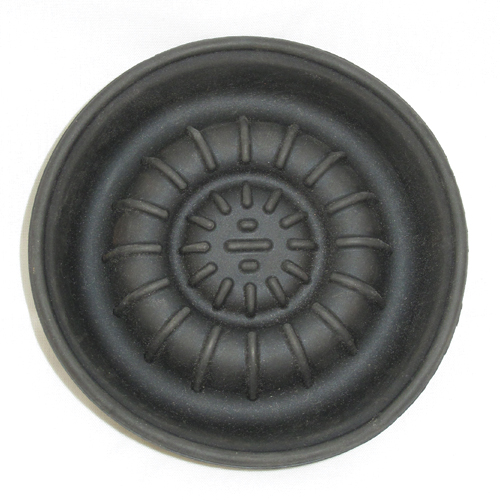
Dampers and Isolators
Molded Rubber Components for Vibration Control, Shock Absorption, and Noise Reduction
Rubber isolators and dampers are molded elastomeric components designed to absorb shock, control vibration, and reduce noise transmission between mechanical assemblies. Moldtech produces both to custom geometry, durometer, and load specifications in-house at our 50,000 sq. ft. facility in Lancaster, NY.
Rubber Dampers
A rubber damper is a molded component that dissipates kinetic energy from impact, shock, or cyclic motion, converting it to heat through the internal friction of the elastomer. Vibration dampers and rubber shock mounts are installed between a vibration source and the structure or equipment it’s mounted to, reducing peak forces transmitted through the assembly and protecting sensitive components from fatigue and mechanical failure.
Moldtech produces rubber dampers across a full range of durometers, geometries, and compound formulations to match the frequency, amplitude, and load requirements of the application. For assemblies requiring a bonded metal insert, stud, or bracket, Moldtech’s overmolding and bonding process integrates the hardware directly into the part during molding.
Common damper configurations:
- Rubber engine mounts and motor mounts
- Rubber buffers and bumpers
- Shock mounts and shock absorber pads
- Anti vibration pads and mats
- Vibration damping mounts with bonded metal hardware
- Cylindrical, conical, and sandwich-style rubber dampers
Rubber Isolators
A rubber isolator is a molded elastomeric mount that decouples a piece of equipment from the structure supporting it, reducing the transmission of vibration and structure-borne noise in both directions. Vibration isolators and rubber isolator mounts are selected based on the natural frequency of the elastomer relative to the disturbing frequency of the equipment, giving engineers precise control over isolation performance across a target frequency range.
Moldtech produces rubber isolators for aerospace assemblies, industrial machinery, military hardware, and automotive platforms. Isolator geometry, spring rate, and compound are engineered together to hold static and dynamic load requirements while delivering the isolation efficiency the application demands.
Common isolator configurations:
- Rubber isolation mounts and isolation pads
- Rubber isolator bushings and isolation bushings
- Spring isolators and vibration isolation mounts
- Cylindrical and floor-mount vibration isolators
- Rubber engine and motor mount isolators
- Elastomeric isolators with bonded or threaded inserts
Elastomer Materials
Material selection is based on the load, operating temperature, chemical exposure, and dynamic performance requirements of the application.
| Elastomer | Temp Range | Key Properties | Common Applications |
| Natural Rubber (NR) | -65°F to +180°F | High resilience; excellent dynamic fatigue life | Vibration isolators, shock mounts |
| Neoprene (CR) | -40°F to +250°F | Weather, ozone, and oil resistance | General industrial, marine mounts |
| Nitrile (NBR / Buna-N) | -40°F to +250°F | Oil and petroleum resistance | Engine and motor mounts, automotive |
| EPDM | -65°F to +300°F | Ozone, steam, and weather resistance | Outdoor, HVAC, infrastructure isolators |
| Silicone (VMQ) | -65°F to +400°F | Wide temp range; stable damping properties | High-temp and low-temp isolators |
| Fluorocarbon (FKM / Viton) | -20°F to +400°F | Broad chemical and fuel resistance | Aerospace, under-hood dampers |
| Polyurethane (PU) | -40°F to +200°F | High load capacity; abrasion and tear resistance | Heavy-duty shock mounts, buffers |
| Hytrel (TPC-ET) | -65°F to +300°F | High flex fatigue resistance; low compression set | Dynamic isolators, suspension dampers |
Additional compounds available: HNBR, SBR, Thermoplastic Vulcanizate (TPV), Hypalon (CSM), Aflas (TFE/P).
Specialty Formulations
Available for applications with specific performance or regulatory requirements:
- Flame retardant
- Low-temperature flex rated
- Antistatic / ESD
- Metal detectable
- High / ultra strength
- Fabric-reinforced
- Food grade
Design Considerations
Rubber dampers and isolators are engineered around the load and vibration profile of the application. Design optimization is driven by the following:
- Static and dynamic load requirements
- Natural frequency and disturbing frequency relationship
- Required isolation efficiency across the operating frequency range
- Operating temperature range
- Chemical and fluid exposure
- Shock loading and impact requirements
- Mounting method (bonded insert, threaded stud, bracket, clamp)
- Compression set and fatigue life over service life
Durometer selection directly affects spring rate, load capacity, and isolation performance. Moldtech’s engineering team works with customers to model natural frequency and deflection under load, ensuring the finished damper or isolator performs as specified rather than requiring field iteration.
Get a Quote for Custom Rubber Dampers and Isolators
Rubber dampers and isolators are engineered to order. Contact Moldtech’s team to discuss load requirements, geometry, compound, and production volume for your application.