
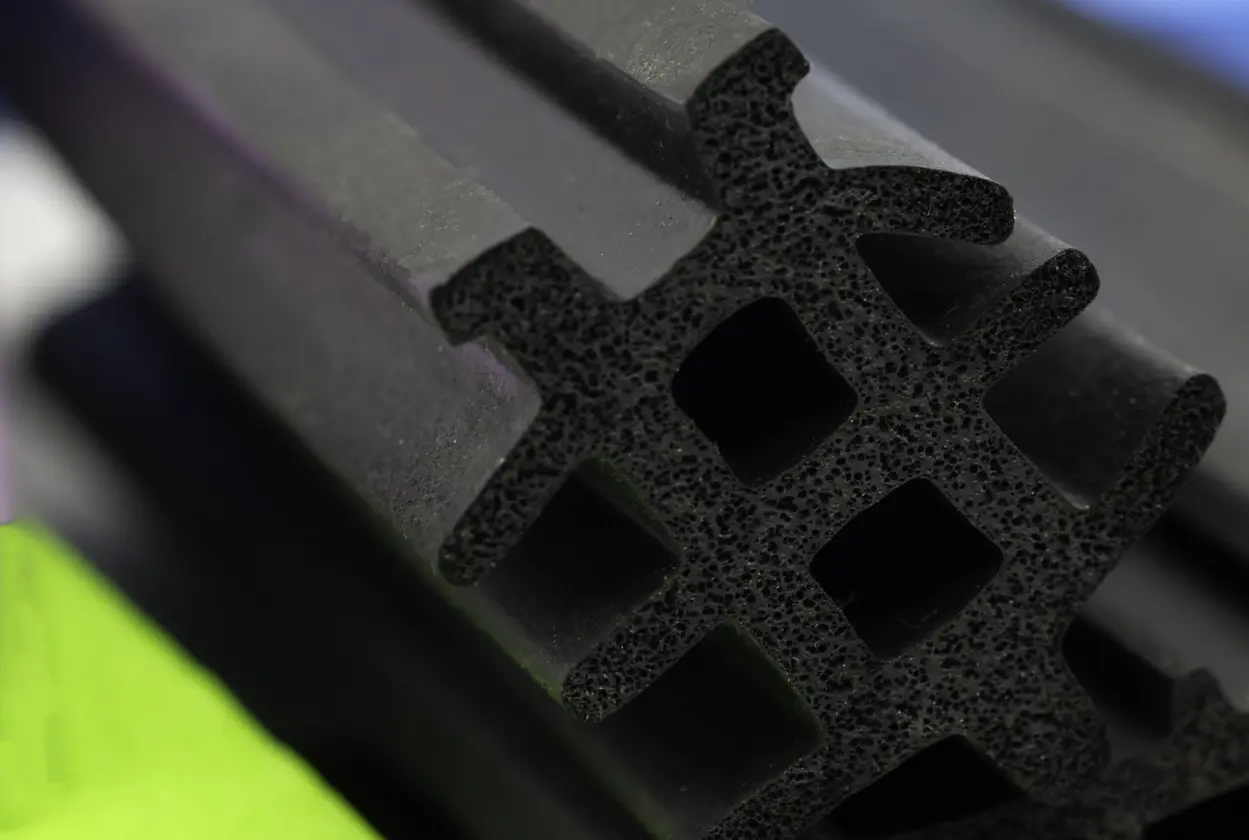
Sponge/Foam Molding
Does your part need extra strength without added weight? Moldtech’s foam injection molding process delivers exactly that. We use a controlled blowing agent to form a tough, seamless rubber skin around a lightweight foamed core, giving you a part that’s structurally sound but noticeably lighter than a solid-rubber equivalent. This single-shot molding method can cut part weight by up to 15%, which translates to easier handling, lower shipping costs, and real material savings at scale. Read on to see how our sponge and foam molding capabilities can support your next project, or reach out to our team for a quote.
How Foam and Sponge Rubber Molding Works
Foam (or “sponge”) injection molding is a variation on standard rubber injection molding. Instead of producing a fully dense part, we introduce a chemical blowing agent into the rubber compound before it’s injected into a heated mold. As the material cures, the blowing agent releases gas, expanding the rubber into a cellular, foamed structure while the outer surface cures against the mold wall to form a smooth, solid skin. The result is a part with a molded elastomer core that’s soft, compressible, and low-density, wrapped in a durable outer layer that holds up to handling and environmental exposure.
Depending on your application, we can engineer the foam structure as either:
- Closed-cell sponge: individual cells are sealed off from one another, making the part resistant to moisture and fluid absorption. Well suited for gaskets, seals, and outdoor applications.
- Open-cell sponge: cells are interconnected, producing a softer, more compressible part with better cushioning and sound-dampening properties.
We work with a range of elastomers for foam and sponge molding, including EPDM, silicone, neoprene, and nitrile, and can match the cell structure, density, and durometer to the demands of your application.
Benefits of Foam Injection Molding
- Reduced weight: cutting part weight by up to 15% without giving up structural integrity
- Lower material costs: less rubber compound used per part at volume
- Thermal and acoustic insulation: the cellular structure traps air, improving insulating performance
- Design flexibility: we can vary wall thickness, density, and skin thickness within a single part to meet specific performance targets
Common foam-molded parts include gaskets, seals, cushioning components, vibration isolators, and weatherstripping, anywhere a part needs to be lightweight, compressible, or insulating without losing durability.
Industry Specific Benefits
The reasons foam molding matters shift depending on the industry. In aerospace and military applications, every gram counts, so a 15% weight reduction on a bracket seal or gasket can add up across an entire aircraft or vehicle platform, all while still meeting strict performance and durability standards.
Automotive manufacturers lean on foam molded parts for cushioning and vibration isolation, where a compressible core helps dampen noise and absorb shock without adding bulk to the assembly.
In medical equipment, the same properties that make foam rubber lightweight also make it gentle and comfortable against the skin, which matters for wearable devices and patient-contact components.
Industrial and electronics applications often value foam molding for its insulating qualities: the cellular structure traps air, which helps manage sound, temperature, or minor pressure differentials in enclosures and housings.
Across all of these industries, the underlying advantage is the same. Foam molding gives engineers a way to hit weight, cushioning, or insulation targets that a solid rubber part simply can’t reach on its own.
Why Trust Moldtech for Foam Injection Molding?
Moldtech is known in the industry for solving complex engineering challenges. For decades, we’ve been a go-to partner for critical applications. When you need an expert to handle your foam and sponge molding project, turn to us.
Operating out of nearly 50,000 square feet of vertically integrated production space in Lancaster, NY, we manage every step of the manufacturing process, from initial design through final delivery to your facility. That means unmatched quality control on every part we produce. Our facility runs 24 hours a day, five days a week, so we can respond quickly to urgent requests, whether that’s a single prototype or a large production run. If your project calls for additional safeguards, we also offer cleanroom and climate-controlled environments.
Backed by decades of experience, we’re ready to take on even the most challenging foam molding projects. We’re trusted by organizations like Boeing, Bosch, Johnson & Johnson, and the U.S. military. If you need high-quality, lightweight rubber parts that stand up to tough environments, trust Moldtech.
Get a Quote Today
Ready to learn more about what we can do for you? Our team is ready to get the details of your project and create a detailed quote. Contact us today to get started.