
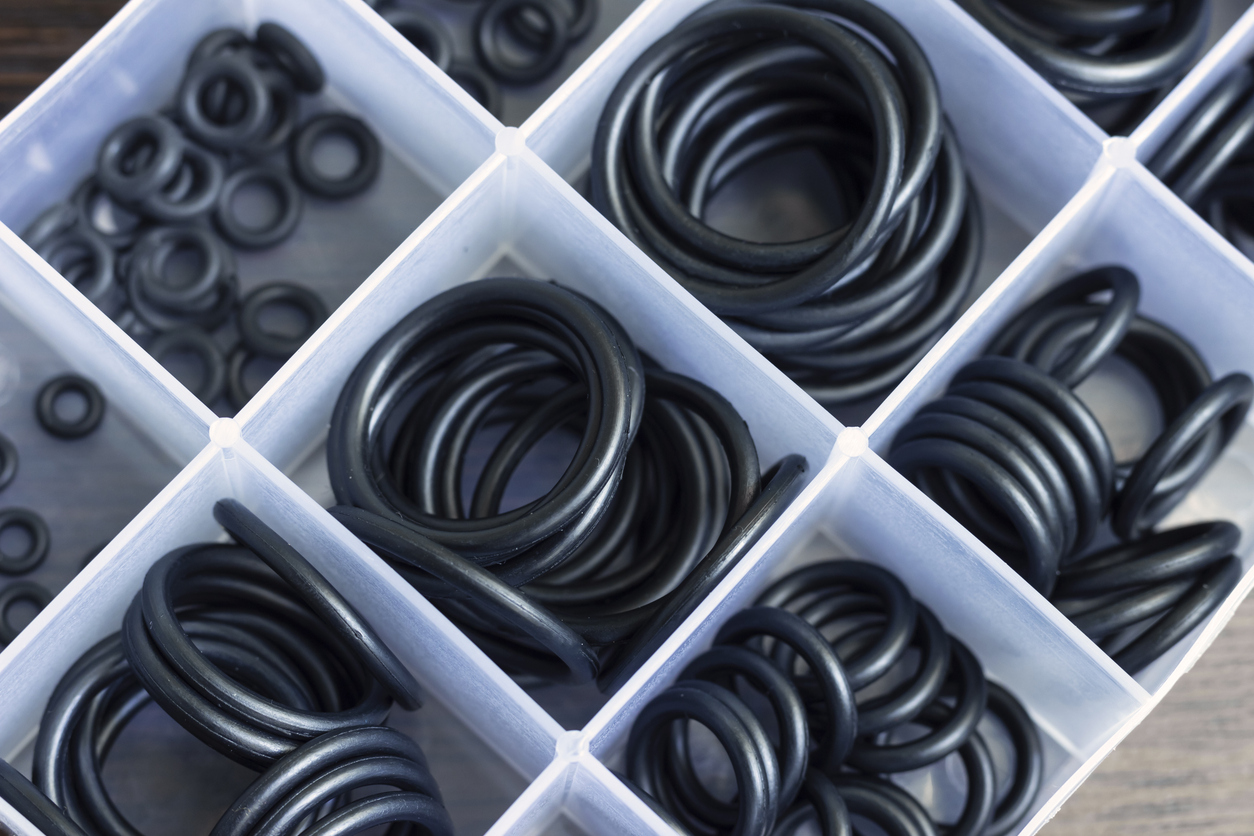
Seals and Gaskets
Custom Molded Rubber Seals and Gaskets for Leak-Proof Performance
Rubber seals and gaskets are molded components engineered to close the gap between two mating surfaces, preventing the passage of fluids, gases, dust, and other contaminants under pressure, vibration, and temperature extremes. As a custom gasket manufacturer, Moldtech produces both to exact geometry, compound, and durometer specifications in-house at our 50,000 sq. ft. facility in Lancaster, NY.
Rubber Seals
A rubber seal is a molded component that maintains a barrier between two surfaces, or between a moving and stationary part, to contain pressure or exclude contaminants. Rubber seals are used in static joints as well as dynamic applications where the seal must maintain contact against a rotating shaft, reciprocating rod, or sliding interface without losing sealing force over its service life.
Moldtech engineers custom rubber seals around the application’s pressure differential, temperature range, chemical exposure, and motion requirements, then selects compound and cross-section geometry to match. For applications combining a rubber seal with a rigid substrate, our overmolding and bonding process bonds the elastomer directly to metal or plastic components during molding.
Common seal configurations:
- O-rings and custom cross-section profiles
- Lip seals and rotary shaft seals
- Face seals and static seals
- Molded-in-place (MIP) seals
- Bonded seal assemblies with metal or plastic inserts
Rubber Gaskets
A rubber gasket is a molded, flat, or profiled component compressed between two mating flanges or housing surfaces to create a static seal. Unlike a dynamic seal, a gasket does not move relative to the surfaces it seals against; it relies on compression set resistance and surface conformity to maintain a leak-proof barrier over time, temperature cycling, and mechanical load.
Moldtech produces custom rubber gaskets in cut, molded, and die-formed configurations, including gaskets with integrated ribs, beads, or sealing lips molded directly into the part to improve sealing force at low compression loads. As a rubber gasket manufacturer serving aerospace, defense, medical, and industrial customers, we work from customer prints, 3D models, or reverse-engineered samples to match fit, form, and performance.
Common gasket configurations:
- Flat, molded, and die-cut gaskets
- Flange and housing gaskets
- Beaded and lip-profile gaskets
- EPDM, silicone, and fluorocarbon sealing gaskets
- Gaskets with integrated metal carriers or reinforcement
Elastomer Materials
Material selection for a rubber seal or rubber gasket is driven by the operating temperature, chemical and fluid exposure, compression set requirements, and regulatory standards of the application.
| Elastomer | Temp Range | Key Properties | Common Applications |
| EPDM | -65°F to +300°F | Excellent ozone, steam, and weather resistance; poor oil resistance | Outdoor gaskets, HVAC, water and steam seals |
| Nitrile (NBR / Buna-N) | -40°F to +250°F | Strong oil and petroleum resistance | Automotive gaskets, hydraulic seals |
| Silicone (VMQ) | -65°F to +400°F | Wide temperature range; low compression set | Silicone gaskets for food, medical, and high-temp seals |
| Fluorocarbon (FKM / Viton) | -20°F to +400°F | Broad chemical and fuel resistance | Aerospace seals, chemical processing gaskets |
| Neoprene (CR) | -40°F to +250°F | Weather and ozone resistance; moderate oil resistance | General industrial gaskets, marine seals |
| HNBR | -40°F to +300°F | High/low temp stability; superior abrasion resistance | Automotive dynamic seals, oilfield gaskets |
| Fluorosilicone (FVMQ) | -75°F to +350°F | Fuel and oil resistance with silicone's temperature range | Aerospace fuel system seals |
| Natural Rubber (NR) | -60°F to +200°F | High resilience and tear strength | General purpose seals and gaskets |
Additional compounds available: SBR, Hypalon (CSM), Aflas (TFE/P), Polyurethane (PU).
Specialty Formulations
Available for applications with specific performance or regulatory requirements:
- Food grade / FDA and USP Class VI compliant
- Flame retardant
- Low-temperature flex rated
- Antistatic / ESD
- Metal detectable
- High / ultra strength
- Low compression set formulations
Design Considerations
Rubber seals and gaskets can be engineered to virtually any geometry and cross-section. Design optimization is driven by the following:
- Pressure differential and sealing force requirements
- Operating temperature range and thermal cycling
- Chemical, fuel, and fluid exposure
- Static versus dynamic sealing conditions
- Compression set and long-term sealing retention
- Surface finish and flange flatness of mating components
- Regulatory and material traceability requirements (aerospace, medical, food grade)
Compression set is a critical design variable for any rubber seal or rubber gasket held under sustained load. Moldtech’s compound selection and rubber injection molding process are engineered to minimize compression set over the part’s service temperature range, maintaining sealing force through repeated thermal cycling.
For gaskets and seals used in medical or food processing applications, Moldtech’s clean room and climate-controlled production areas support the material traceability and process controls these industries require. For small-cross-section or miniature seals used in electronics and connector applications, our micro molding capability holds tight tolerances that standard tooling cannot achieve.
Get a Quote for Custom Rubber Seals and Gaskets
Rubber seals and gaskets are engineered to order. Contact Moldtech’s team to discuss geometry, compound, and production volume requirements for your application.