
Rollers and Wheels
Custom Rubber Wheels and Rubber Rollers Built for Demanding Applications
Rubber Wheels and rubber rollers are molded components used to convey, guide, press, and support loads in mechanical systems and material handling equipment. As a rubber roller and rubber wheel manufacturer, Moldtech produces both to precise geometry, durometer, and bonding specifications in house at our 50,000 sq. ft. facility in Lancaster, NY. Whether you need industrial rubber rollers for a conveyor line or custom Rubber Wheels for a cart, dolly, or caster assembly, our vertically integrated process keeps tooling, molding, and quality control under one roof.
Rubber Rollers
A rubber roller is a cylindrical molded component, typically bonded or bonded-in-place over a steel, aluminum, or plastic core, used to convey, guide, drive, or apply pressure to material moving through a machine or process line. Industrial rubber rollers are found in conveyor systems, printing and laminating equipment, textile processing lines, and packaging machinery, where consistent surface friction, durometer, and dimensional accuracy directly affect product quality and equipment uptime.
Moldtech produces custom rubber rollers to specified bore diameter, face width, crown profile, and hardness. For applications requiring a bonded metal shaft or hub, our overmolding and bonding process integrates the insert during molding, eliminating a separate assembly step.
Common roller configurations:
- Rubber coated rollers and rubber covered rollers molded over customer-supplied or Moldtech-sourced cores
- Rubber conveyor rollers and rubber covered conveyor rollers for material handling lines
- Urethane rollers and urethane drive rollers for high-wear, low-friction applications
- Silicone rubber rollers for high-heat or food-contact processes
- Hardened rollers and vulcanized rubber rollers for heavy-load, continuous-duty environments
- Custom rubber rollers built to a customer print, sample, or performance specification
Moldtech supplies industrial rubber rollers across aerospace, automotive, food processing, and general industrial markets, with material selection driven by the specific friction, chemical exposure, and temperature requirements of each application.
Rubber Wheels
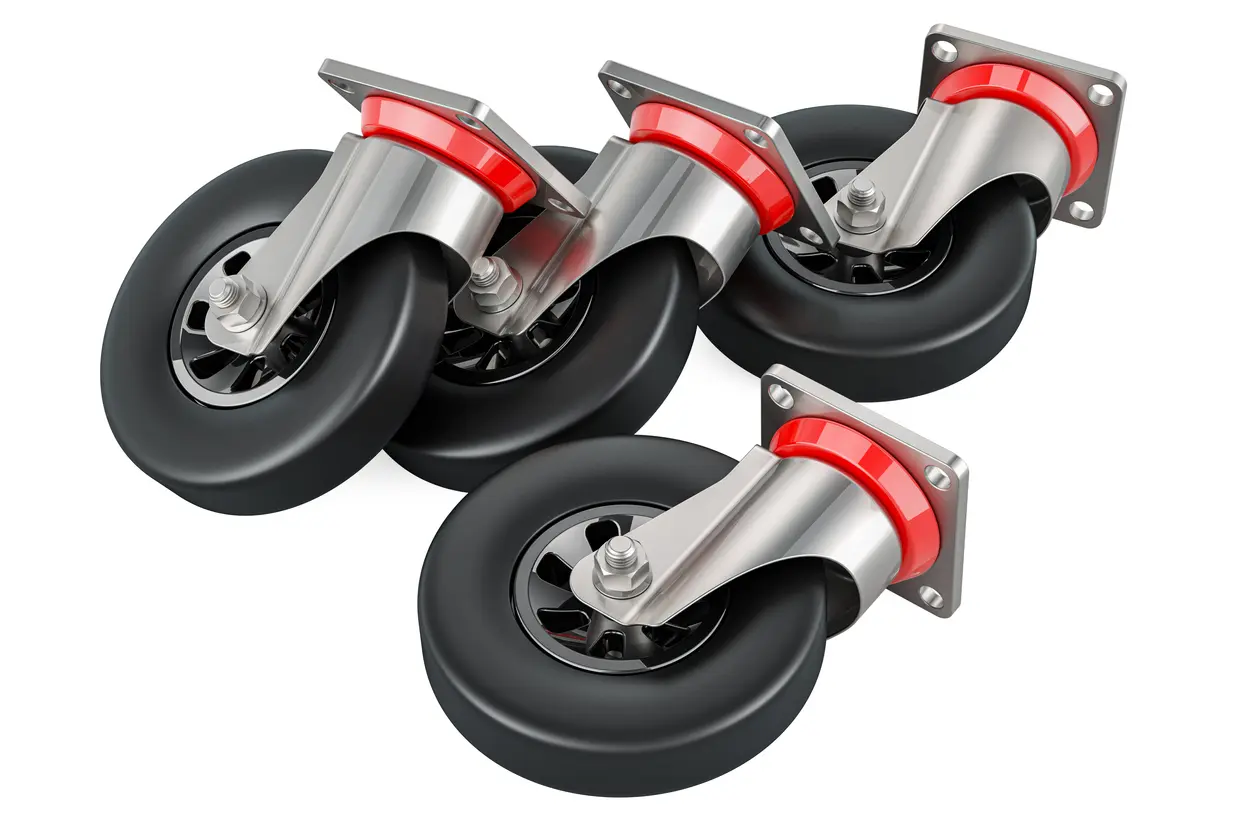
A rubber wheel is a molded wheel or tire component, typically bonded to a steel, aluminum, or plastic hub or core, used to support and roll a load across a floor, track, or rail. Rubber Wheels are selected for their shock absorption, floor protection, and quiet operation compared to harder wheel materials, making them a common choice for carts, dollies, casters, and industrial equipment.
Moldtech engineers custom Rubber Wheels to a specified hub bore, tread width, load rating, and durometer. As a rubber wheel manufacturer, we work with customers to match wheel construction to the operating floor surface, load, and duty cycle of the application.
Common wheel configurations:
- Solid rubber wheels molded onto steel, aluminum, or plastic hubs
- Rubber caster wheels and heavy duty rubber casters for carts, dollies, and material handling equipment
- Polyurethane wheels and polyurethane caster wheels for applications requiring higher load capacity or reduced rolling resistance
- Custom Rubber Wheels engineered to a specified hub bore, tread profile, and durometer
- Rubber wheel and roller assemblies combining a molded wheel with an integrated bearing or bushing
Rubber vs. polyurethane: Choosing between rubber and polyurethane for a wheel or caster typically comes down to floor surface, load, and noise requirements. Rubber generally provides better shock absorption and quieter operation, while polyurethane offers higher load capacity and better resistance to cuts and abrasion. Moldtech’s team can help evaluate polyurethane vs. rubber casters for a given application during the quoting process.
Elastomer Materials
Material selection is based on the load, operating temperature, chemical exposure, and floor or surface conditions of the application.
| Elastomer | Temp Range | Key Properties | Common Applications |
| Natural Rubber (NR) | -40°F to +180°F | High resilience, good abrasion and tear resistance | General-purpose rollers and wheels |
| Nitrile (NBR / Buna-N) | -40°F to +250°F | Oil and petroleum resistance | Industrial rubber rollers, conveyor rollers |
| Neoprene (CR) | -40°F to +250°F | Weather, ozone, and oil resistance | Outdoor casters, conveyor rollers |
| EPDM | -65°F to +300°F | Ozone, weather, and steam resistance | Outdoor equipment wheels |
| Silicone (VMQ) | -65°F to +400°F | Wide temperature range, food-contact grades available | Silicone rubber rollers, food processing |
| Polyurethane (PU) | -40°F to +200°F | High abrasion and tear resistance, high load capacity | Urethane rollers, polyurethane wheels |
| Hard Rubber / Vulcanized Rubber | -20°F to +200°F | High durometer, wear resistance | Hardened rollers, heavy duty rubber wheels |
Additional compounds available: SBR, Hypalon (CSM), HNBR.
Specialty Formulations
Available for applications with specific performance or regulatory requirements:
- Food grade
- Antistatic / ESD
- Chemical and oil resistant
- Abrasion and cut resistant
- Non-marking, for use on finished floors
- Flame retardant
Design Considerations
Rubber rollers and Rubber Wheels can be engineered to virtually any load, geometry, or duty cycle. Design optimization is driven by the following:
- Load capacity and duty cycle
- Bore, shaft, or hub dimensions and mounting method
- Durometer and tread or crown profile
- Operating temperature range
- Chemical, oil, or UV exposure
- Floor or surface requirements, including non-marking and noise reduction needs
- Bonding method, including rubber-to-metal bonding, overmolding, or press-fit assembly
Get a Quote for Custom Rubber Rollers and Rubber Wheels
Rubber rollers and Rubber Wheels are engineered to order. Contact Moldtech’s team to discuss geometry, compound, load rating, and production volume requirements for your application.