
Hoses and Tubes
Molded Rubber Hoses and Tubing for Fluid, Air, and Chemical Transfer
Rubber hoses and rubber tubing are flexible molded components used to convey air, fluids, fuel, and chemicals through mechanical and fluid-handling systems. Moldtech manufactures both to custom geometry, compound, and performance specifications in-house at our 50,000 sq. ft. facility in Lancaster, NY. As a full-service rubber products supplier, we support everything from a single prototype hose to full production volumes of industrial hoses and tubing assemblies.
Rubber Hoses
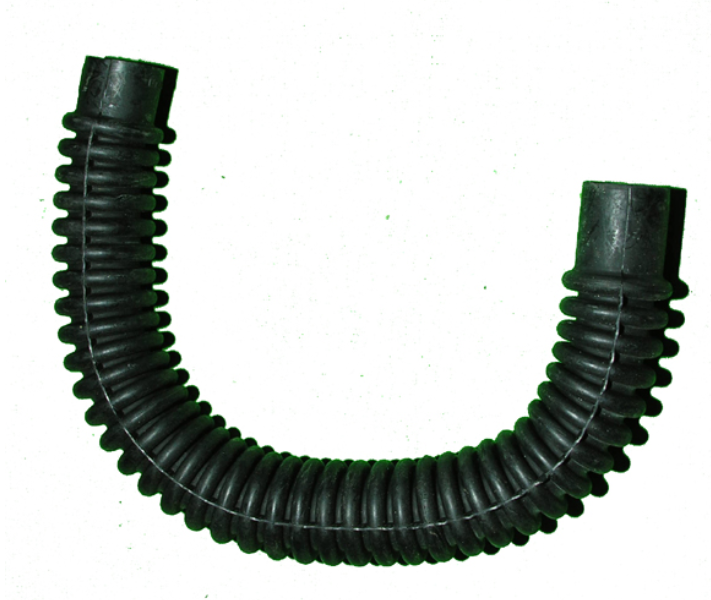
A rubber hose is a molded or formed flexible conduit engineered to hold a fixed shape, routing, or bend radius so it can be installed directly into a system without additional support. Unlike straight-extruded tubing, molded hose can be produced with pre-set bends, integrated fittings, and varying wall thickness along its length, properties that make it well suited to routing-critical applications such as rubber fuel hose and fuel line assemblies, custom radiator hoses, rubber air hose, and rubber water hose circuits.
For hose assemblies that require a metal insert, flange, or fitting bonded directly into the hose end, Moldtech’s overmolding and bonding process integrates the component during molding, eliminating a downstream assembly step and a potential leak path.
Common hose configurations:
- Molded, pre-formed hose with fixed bends and routing geometry
- Fabric- or wire-braid-reinforced hose for higher pressure ratings
- Straight and custom-formed lengths
- Integrated flanges, fittings, or metal inserts overmolded to the hose end
- Multi-durometer or co-molded hose assemblies
- Automotive hose for fuel, coolant, and emissions systems
Rubber Tubing
Rubber tubing is a flexible, typically constant-cross-section tube used for lower-pressure fluid transfer, air transfer, and routing applications where the tubing is cut to length and installed in the field rather than molded to a fixed shape. Moldtech produces rubber tubing in a full range of inside diameters, outside diameters, and wall thicknesses, from small-bore 1/4 in. and 3/8 in. tubing up to 3 in. and larger.
Silicone tubing is a common choice where flexibility across a wide temperature range or food-grade and medical-grade compliance is required, while EPDM tubing is specified for weather, ozone, and steam resistance. Moldtech also produces surgical tubing for medical device applications and food-grade tubing for food and beverage processing equipment.
Common tubing configurations:
- Single-lumen and multi-lumen profiles
- Thin-wall and heavy-wall constructions
- Custom ID/OD dimensions across the full standard size range
- Braided or fabric-reinforced tubing for higher pressure service
- FDA-compliant and food-grade tubing for food and beverage applications
- Medical-grade surgical tubing
Elastomer Materials
Material selection is based on the operating temperature, pressure, chemical exposure, and regulatory requirements of the application.
| Elastomer | Temp Range | Key Properties | Common Applications |
| Nitrile (NBR / Buna-N) | -40°F to +250°F | Oil and fuel resistance | Rubber fuel hose, fuel line, hydraulic hose |
| EPDM | -65°F to +300°F | Ozone, steam, and weather resistance | Coolant hose, EPDM tubing, outdoor/HVAC |
| Silicone (VMQ) | -65°F to +400°F | Wide temperature range; flexible at low temps; food-grade options | Silicone tubing, silicone hose, high-temperature hoses |
| Fluorocarbon (FKM / Viton) | -20°F to +400°F | Broad chemical and fuel resistance | Chemical transfer, under-hood, fuel systems |
| Neoprene (CR) | -40°F to +250°F | Weather, ozone, and flex fatigue resistance | General industrial hose |
| Natural Rubber (NR) | -60°F to +180°F | High resilience and abrasion resistance | Rubber air hose, rubber water hose |
Additional compounds available: HNBR, SBR, Hypalon (CSM), Aflas (TFE/P).
Specialty Formulations
Available for hose and tubing applications with specific performance or regulatory requirements:
- Food grade / FDA-compliant
- High-temperature rated
- Low-temperature flex rated
- Antistatic / ESD
- Metal detectable
- Fabric- or wire-reinforced for high-pressure service
- Fuel- and chemical-resistant
Design Considerations
Rubber hoses and tubing can be engineered to virtually any diameter, wall thickness, and routing geometry. Design optimization is driven by the following:
- Inside diameter, outside diameter, and wall thickness tolerances
- Operating pressure and burst pressure requirements
- Operating temperature range
- Chemical, fuel, and fluid compatibility
- Bend radius and routing/installation constraints
- End configuration (straight cut, molded fitting, flange, overmolded insert)
- Reinforcement requirements for pressure or vacuum service
Integrated fittings and inserts are a critical design variable in molded hose. Bonding a metal or plastic fitting directly into the hose during molding, rather than clamping a fitting on after the fact, removes a mechanical joint that could otherwise loosen or leak under vibration, pressure cycling, or thermal expansion.
For small-diameter tubing used in medical or electronics applications, Moldtech’s micro molding capability supports tight-tolerance, small-cross-section tubing where standard extrusion or tooling cannot hold the required geometry.
Get a Quote for Custom Rubber Hoses and Tubes
Rubber hoses and tubing are engineered to order. Contact Moldtech’s team to discuss geometry, compound, end configuration, and production volume requirements for your application.